
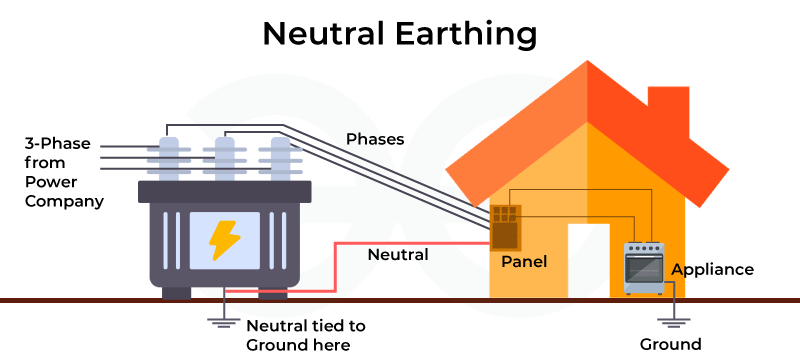
Importance of Neutral Earthing
Importance of Neutral Earthing in Electrical Systems
Introduction
Neutral earthing is a vital aspect of modern electrical power systems. It plays a key role in maintaining system stability, improving fault detection, and ensuring overall electrical safety. Without proper neutral earthing, electrical systems can experience unstable voltages, equipment damage, and increased risk to human life.
By connecting the neutral point of electrical equipment to the earth, fault currents can be controlled and safely dissipated, allowing protective devices to operate correctly during abnormal conditions.
What Is Neutral Earthing?
Neutral earthing is the practice of connecting the neutral point of a transformer or generator to the ground. This connection may be made directly or through an impedance such as a resistor or reactor.
The main purpose of neutral earthing is to provide a controlled path for fault currents during conditions such as line-to-ground faults. By doing so, it stabilizes the electrical system and ensures that protective devices can detect and isolate faults quickly.
Neutral earthing is widely used in power distribution networks, industrial plants, and electrical substations to improve operational safety and reliability.
Why Neutral Earthing Is Important
Neutral earthing offers several important benefits for electrical systems:
1. Stabilizes System Voltage
It maintains balanced voltage levels across all phases and prevents abnormal voltage fluctuations.
2. Controls Fault Current Magnitude
Neutral earthing helps regulate the amount of current flowing during ground faults, preventing excessive damage.
3. Protects Equipment Insulation
By limiting voltage rise during faults, it protects insulation systems in cables, transformers, and electrical equipment.
4. Reduces Risk of Electric Shock
Proper earthing ensures that fault currents flow safely to the ground rather than through exposed metal parts.
5. Improves Protection Relay Performance
Earthing allows protective relays and circuit breakers to detect faults accurately and operate quickly.
These benefits make neutral earthing an essential part of safe and reliable electrical network design.
Types of Neutral Earthing
Different earthing methods are used depending on system voltage levels, network design, and operational requirements.
1. Solid Neutral Earthing
In this method, the neutral is directly connected to the ground without any impedance. It allows high fault current and is commonly used in low-voltage systems.
2. Resistance Earthing
A resistor is inserted between the neutral and ground to limit the fault current to a safe value. This method is widely used in industrial systems.
3. Reactance Earthing
A reactor is used between the neutral and earth to control fault current magnitude.
4. Resonant Earthing (Petersen Coil)
This method uses an inductive coil to cancel out capacitive fault currents in the system. It is often used in medium-voltage networks.
The choice of neutral earthing method depends on the system design, voltage level, and protection requirements.
Risks of Improper Neutral Earthing
If neutral earthing is not properly designed or maintained, several problems may arise in the electrical system.
Common risks include:
- Excessive fault currents
- Damage to electrical equipment
- Fire hazards
- Unstable system voltages
- Malfunction of protection systems
Improper earthing can compromise the safety of the entire electrical installation and increase operational risks.
Neutral Earthing and Ground Resistance
For neutral earthing to function effectively, the grounding system must maintain low earth resistance. High soil resistivity or poor grounding design can increase earth resistance and reduce the effectiveness of neutral earthing.
To improve grounding performance, earthing enhancement materials are often used. Solutions such as Control-R Gel help reduce soil resistivity and create a stable conductive path between the electrode and the surrounding soil.
These materials help maintain consistent grounding performance even in challenging soil conditions.
Conclusion
Neutral earthing is a fundamental component of safe and stable electrical systems. It controls fault currents, stabilizes system voltages, and ensures that protective devices operate effectively during faults.
By implementing a properly designed earthing system and maintaining low ground resistance, electrical networks can achieve higher reliability and improved safety. Effective neutral earthing ultimately protects both electrical infrastructure and the people who depend on it.